
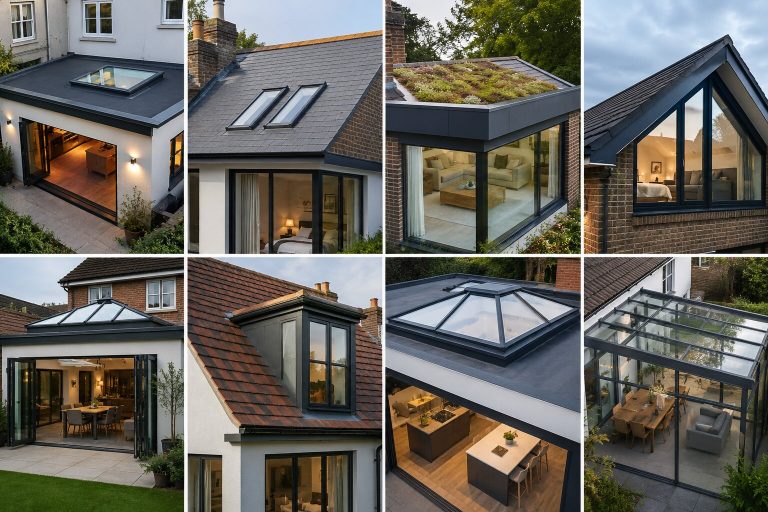
8 Roof Extension Ideas – Flat, Pitched, Glass and Lantern Options Compared
The roof shapes almost everything else about a house extension: what it costs, how straightforward planning is, how the finished room feels to sit in, and what the whole thing looks like from the garden. Get this decision right early, and the rest tends to follow. In Essex right now, there are essentially eight roof options worth considering for a single storey extension: a flat roof, a pitched roof matching the house, a pitched roof with a vaulted ceiling inside, a flat roof topped with a glass lantern, a full glass roof, a lean-to, a flat roof with rooflights scattered across it, and a solid insulated roof built the traditional way.
For a standard 4m x 4m single-storey shell in Essex, prices run from around £28,000 for a simple lean-to up to roughly £55,000 for a full glass roof. These figures cover the roof and shell only; for a full breakdown of house extension costs in Essex, including fit-out and professional fees, see our complete cost guide. What follows breaks down each roof option, what it costs, what it looks like, and which kind of project it actually suits.
- Roof Options Compared at a Glance
- Idea 1: Flat Roof Extension
- Idea 2: Pitched Roof Extension to Match the House
- Idea 3: Pitched Roof With Vaulted Ceiling
- Idea 4: Flat Roof With Glass Lantern
- Idea 5: Full Glass Roof Extension
- Idea 6: Lean-To Mono-Pitch Roof
- Idea 7: Flat Roof With Multiple Rooflights
- Idea 8: Solid Insulated Traditional Roof
- Summary
- Frequently Asked Questions
Roof Options Compared at a Glance
| Roof type | From (Essex 2026) | Cost | Popularity | Planning | Best for |
| 1. Flat roof | from £35k | Low | High | ✓ PD usually | Budget-friendly, modern look |
| 2. Pitched (matching) | from £40k | Low-Med | High | ✓ PD usually | Best for period homes, blends in |
| 3. Pitched (vaulted) | from £42k | Med | High | ✓ PD usually | Drama inside, extra volume |
| 4. Glass lantern | from £43k | Med-High | High | ✓ PD usually | Maximum kitchen light |
| 5. Full glass roof | from £55k | High | Med | ✓ PD usually | Premium, design statement |
| 6. Lean-to (mono-pitch) | from £28k | Lowest | High | ✓ PD usually | Simplest, cheapest option |
| 7. Rooflights only | from £33k | Low | High | ✓ PD usually | Subtle overhead light, lower cost |
| 8. Solid insulated (trad) | from £38k | Low | High | ✓ PD usually | Classic look, low maintenance |
A quick note on the ‘Low / Med / High’ cost column: it’s relative across these eight options, not an absolute judgment. A flat roof being marked ‘Low’ just means it’s the cheapest of this particular lineup, not that it’s a bargain in absolute terms. All figures assume a standard 4m x 4m single-storey shell build in Essex for 2026, and exclude fit-out and professional fees.
Not sure which roof type suits your extension?
Kirkwood looks at every project on its own terms — planning position, house type, budget, and what you’re actually going for design-wise all feed into the recommendation. Get a free quote for your project in Essex.
Idea 1: Flat Roof Extension
A flat roof isn’t actually dead flat; there’s usually a slope of 1 to 2 degrees built in purely for drainage, but visually and to the eye, it reads as flat.
It’s the go-to choice for anyone after a modern-looking extension in Essex right now. The clean lines suit aluminium bi-fold or sliding doors particularly well, and because there’s no pitch cutting into the ceiling, you get every last bit of internal headroom the extension has to offer.
On cost: a flat roof single-storey extension in Essex starts from around £35,000 for a standard 4m x 4m shell in 2026, working out to roughly £1,800 to £2,200 per m² for the build itself. Worth knowing, modern building regulations around insulation mean a flat roof now costs about the same as a pitched one, which wasn’t always the case.
This roof type is especially popular on kitchen extensions, since a flat roof makes it easy to drop large rooflights straight above the cooking or dining zone, something a pitched roof structure simply can’t do as cleanly.
On planning: most flat roof rear extensions of this size sail through as permitted development, though it’s always worth getting a Lawful Development Certificate to have it in writing.
Where it works best: anyone chasing a contemporary look, maximum headroom, or planning to bolt on rooflights down the line. It suits pretty much any house type, but tends to look especially sharp on semi-detached homes across Chelmsford, Billericay, and Brentwood.
Typical cost: From £35,000 for a 4m x 4m shell build in Essex, 2026. From £1,800 per m². Planning: Usually permitted development. A Lawful Development Certificate is worth getting. Best for: Modern homes, kitchen-diner extensions, anyone after a clean contemporary finish. |

Idea 2: Pitched Roof Extension to Match the House
A pitched roof extension copies the angle of the existing roof, same pitch, same tiles, same ridge line, so the finished extension looks like it’s simply always been part of the house.
It’s the safest bet for period properties. Planning officers generally favour pitched roofs on traditional homes, and a well-matched one is genuinely hard to spot as an addition once it’s finished.
On roof pitch itself: this just means the angle of the slope, usually expressed in degrees or as a ratio (30°, or 4:12, for example). Most Essex semis built between the 1930s and 1980s sit somewhere between 30° and 45°, and Kirkwood matches whatever your existing roof is doing exactly.
Cost-wise, a pitched roof single-storey extension in Essex starts from £40,000 for a standard 4m x 4m shell in 2026, a touch more than flat, simply because the roof structure itself is more involved to build.
Planning is generally straightforward: pitched roof rear extensions at standard sizes usually count as permitted development, though conservation areas can bring in specific rules around materials.
This is the natural choice for 1930s semis, period terraces, and really any home where keeping the roofline visually consistent matters. It’s a common sight across Billericay, Brentwood, Rayleigh, and Chelmsford.
Typical cost: From £40,000 for a 4m x 4m shell build in Essex, 2026. Planning: Usually permitted development, and generally preferred by planners on traditional properties. Best for: Period homes, 1930s semis, anywhere matching the existing roofline actually matters. |

Idea 3: Pitched Roof With Vaulted Ceiling
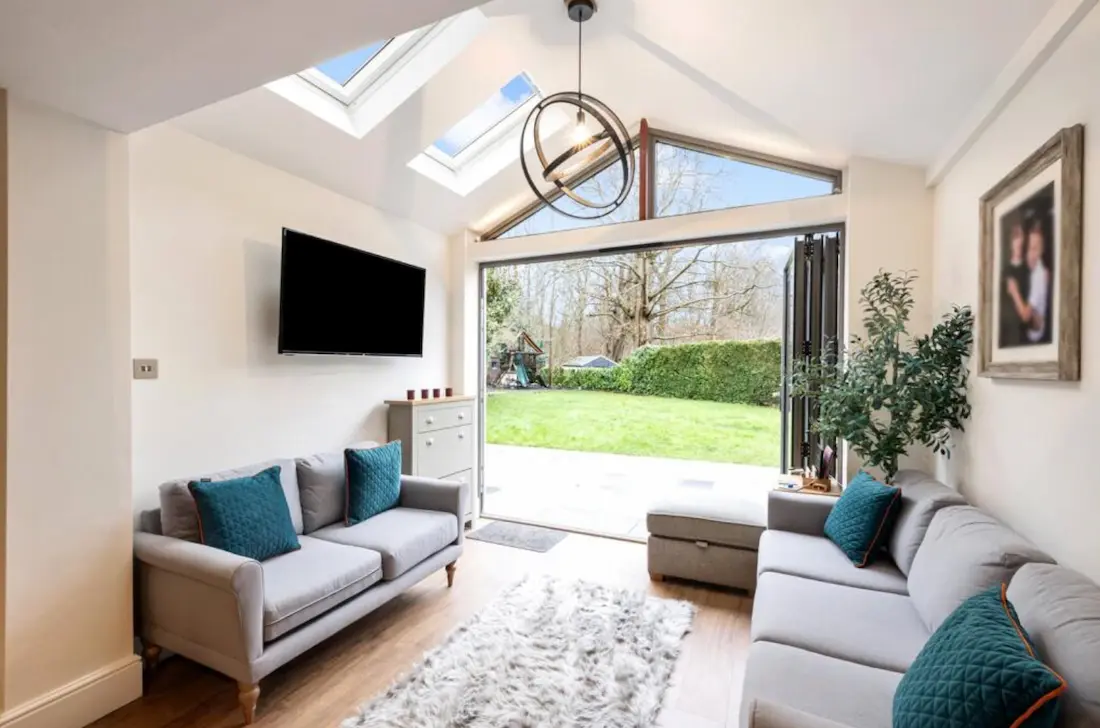
This takes the pitched roof idea and brings it inside; rather than boxing in a flat ceiling underneath the rafters, the ceiling itself follows the slope of the roof, creating a vaulted, almost cathedral-like feel.
The appeal is obvious once you’ve stood in one: you get real volume and drama in the room without adding an inch to the footprint. It’s especially effective paired with a glazed gable at the end wall.
On the design side, Velux rooflights or a fully glazed gable can be worked into a vaulted roof to bring light in from up high; combine that with the vaulted ceiling itself, and you end up with a completely different feeling space compared to a standard flat-ceilinged extension.
Cost starts from £42,000 for a 4m x 4m shell in Essex for 2026. The extra structural work needed to achieve the vault, exposed rafters, or engineered timber pushes it slightly above a standard pitched roof.
Planning-wise, it’s treated the same as a standard pitched roof, usually permitted development at typical sizes.
This one really shines in living spaces, open-plan kitchen-dining-living extensions especially, or anywhere you want the room itself to feel like a statement. It’s a popular choice on detached homes across Brentwood and Chelmsford.
Typical cost: From £42,000 for a 4m x 4m shell build in Essex, 2026. Planning: Usually permitted development. Best for: Living spaces and open-plan extensions where interior volume is the whole point. |
Idea 4: Flat Roof With Glass Lantern
Here, a flat roof extension gets a structural glass lantern, a raised glazed box, set centrally above the kitchen or dining space. Because the lantern sits proud of the roof, light comes in both from above and from its sides, not just overhead.
This is the most popular kitchen extension design in Essex right now, and it’s easy to see why: the flat roof keeps the base build cost sensible, while the lantern adds real drama and floods the room you actually spend time in with natural light. Pair it with bi-fold doors on the rear wall, and you’ve got the format most Essex homeowners end up asking for.
The difference from a simple rooflight is worth spelling out: a lantern rises above the roof surface with glazing on all four sides as well as the top, giving a much bigger visual and light impact than something sitting flush.
Cost starts from £43,000 for a 4m x 4m shell including a standard lantern, in Essex for 2026, with the lantern unit itself typically starting around £3,000 on its own.
Planning generally falls under permitted development. This combination of bi-folds plus a central lantern is genuinely the single most requested design across Essex extensions, and it looks particularly good on semis in Chelmsford, Billericay, and Wickford.
Typical cost: From £43,000 for a 4m x 4m shell including lantern, Essex 2026. Lantern unit alone from £3,000. Planning: Usually permitted development. Best for: Kitchen-diner extensions — the classic pairing with bi-fold or sliding doors. |
Idea 5: Full Glass Roof Extension
Sometimes called a glass box extension, this is where the entire roof, not just a section, is glazed. Unlike a lantern sitting on top of a flat roof, there’s no solid roof surface at all here.
The result is maximum light and a genuinely striking finished look; the space feels closer to being outdoors than in. It works especially well as a garden room, an orangery-style living space, or something closer to a studio than a standard extension.
Thermally, modern glass roof systems are built to meet current building regulations, but underfloor heating is well worth including. Summer heat gain is a genuine consideration too; high-performance solar control glass cuts this back significantly, but it needs to be specified from the outset rather than bolted on afterwards.
It’s the priciest of the eight, starting from £55,000 for a 4m x 4m shell in Essex for 2026, reflecting the structural and glazing complexity involved. Planning-wise, most full glass roof extensions still fall under permitted development at standard sizes. Read our full glass roof extensions guide for more detail.
Typical cost: From £55,000 for a 4m x 4m shell build in Essex, 2026. Planning: Usually permitted development. Best for: Garden rooms, design-led projects, homeowners who want natural light above everything else. |

Idea 6: Lean-To Mono-Pitch Roof
A lean-to, also called a mono-pitch, has a single slope running away from the house wall in one direction. It’s the simplest roof structure of all eight options here.
The main reason people choose it is cost. Without a ridge, a hip, or any complex junctions to build, it’s structurally the least involved option going. That makes it a natural fit for smaller extensions, utility rooms, garden rooms, and any project where budget is the driving factor.
It’s worth distinguishing from a flat roof: a flat roof has barely any pitch at all, 1 to 2 degrees, purely for drainage, while a lean-to has a genuinely visible single slope, anywhere from 5 to 30 degrees depending on the design.
Cost starts from £28,000 for a standard lean-to in Essex for 2026, the cheapest of everything on this list.
Planning tends to be straightforward too, since most lean-to extensions qualify as permitted development; the single-slope design often makes it easier to stay within permitted development height limits in the first place.
It suits smaller extensions, utility rooms, budget-conscious projects, and bungalow extensions particularly well. It’s also a solid choice for side extensions, where the slope can drain neatly away from the boundary line.
Typical cost: From £28,000 in Essex, 2026 — the cheapest option here. Planning: Usually permitted development. Best for: Smaller extensions, utility rooms, bungalows, and budget-conscious projects. |
Idea 7: Flat Roof With Multiple Rooflights
Rather than one central glass lantern, this option scatters several individual rooflight units across a flat roof, sitting flush or nearly flush with the roof surface itself.
It’s a cost-effective middle ground; you still get meaningful overhead light, just without the premium price tag of a lantern. And because you can position several rooflights independently, you can put natural light exactly where you want it, over the cooker, above the dining table, over a reading corner, rather than relying on one central source.
On the rooflight units themselves: they come fixed, manually opening, or electrically operated. Electric opening rooflights are a genuinely practical choice above kitchen areas, since they help clear steam and cooking odours, not just add light.
Cost starts from £33,000 for a 4m x 4m flat roof extension with two standard rooflights, in Essex for 2026. Individual units run from around £800 for a fixed rooflight up to £1,800 for an electric opening version.
Planning generally sits under permitted development. This option suits anyone after overhead light without lantern-level spend, and works particularly well on wider or longer extensions where a single central lantern would look out of proportion.
Typical cost: From £33,000 for a 4m x 4m flat roof with two rooflights, Essex 2026. Planning: Usually permitted development. Best for: Budget-conscious light-seekers, and longer extensions where a lantern would look odd. |

Idea 8: Solid Insulated Traditional Roof
Sometimes called a warm roof, this uses standard roofing materials, tiles or slate over a timber structure with rigid insulation board, to produce a well-insulated, low-maintenance roof that looks entirely traditional.
It’s the most conventional-looking of all eight options, ideal where the extension needs to look like it’s always belonged to the house. It’s also genuinely popular for replacing tired conservatory roofs; swapping an ageing polycarbonate or glass roof for a solid, insulated structure turns a conservatory into a room you can actually use year-round.
Worth flagging: a lot of people searching for ‘solid roof extension’ are actually looking to upgrade an existing conservatory rather than build something new; if that’s you, this option applies just as well.
Cost starts from £38,000 for a 4m x 4m solid insulated roof extension shell in Essex for 2026.
Planning-wise, standard single-storey rear extensions with this roof type usually qualify as permitted development, though conservation area properties should check with Kirkwood before going any further.
It suits traditional homes, anyone wanting minimal visual impact, and conservatory-to-extension conversions in particular. It’s a common sight in Brentwood’s conservation areas and across Essex’s older housing stock generally.
Typical cost: From £38,000 for a 4m x 4m shell build in Essex, 2026. Planning: Usually permitted development. Worth checking conservation area rules first. Best for: Traditional homes, conservatory upgrades, and anyone wanting the extension to blend in completely. |
Summary
Which roof actually suits your single-storey extension comes down to your house, your budget, your planning position, and how you want the finished room to feel. If you’re planning a kitchen-diner, a flat roof with a glass lantern generally strikes the best balance of cost, light, and visual impact. If keeping the roofline consistent with the rest of the house matters more than making a statement, a matching pitched roof is almost always the sensible call. And if budget is doing most of the talking, a lean-to or a flat roof with rooflights will get you the most for your money.
Book a free discovery call
Kirkwood designs and builds single-storey extensions across Chelmsford, Brentwood, Billericay, Wickford, Basildon, Rayleigh, Leigh-on-Sea, and Southend. Get a free quote for your specific project.
Frequently Asked Questions
What is the best roof for a single-storey extension?
It depends on your house type, budget, and what the room is for. For kitchen-diner extensions, a flat roof with a glass lantern gives the best mix of cost and natural light. For period homes, a pitched roof matching the existing house is almost always the right call. If budget is the main constraint, a lean-to is the most cost-effective option.
Is a flat roof or pitched roof better for an extension?
It depends on the property and the design you’re after. A flat roof is cheaper, suits modern homes, and works well with rooflights and glass lanterns. A pitched roof costs a bit more but is preferred by planning officers on traditional homes and allows for a vaulted ceiling inside. In 2026, the cost gap between a good flat roof and a pitched roof is smaller than most homeowners expect.
How much does a pitched roof extension cost?
A pitched roof single-storey extension in Essex costs from £40,000 for a standard 4m x 4m shell build in 2026. That’s typically £3,000 to £5,000 more than an equivalent flat roof extension. Adding a vaulted ceiling pushes the cost up further due to the extra structural work involved.
How much does a flat roof extension cost per m2?
A flat roof extension in Essex costs from £1,800 to £2,200 per m² for the shell build in 2026. For a standard 4m x 4m extension, 16m², that works out to a total shell build cost of around £35,000. Cost per m² tends to drop slightly on larger extensions, since costs like groundworks and structural elements don’t scale up in a straight line with floor area.
What is a glass lantern on a house extension?
A glass lantern is a raised glazed structure sitting on top of a flat roof extension. It rises above the roof surface and lets light in from all four sides as well as from above, giving considerably more light than a flush rooflight. Lanterns are most commonly positioned over a kitchen island or dining table, and are the defining feature of modern kitchen-diner extensions across Essex.
What is a lean-to roof extension?
A lean-to, or mono-pitch, roof extension has a single slope falling away from the house in one direction. It’s the simplest and cheapest roof structure available: no ridge, no hip, no complicated junctions. Lean-to extensions in Essex start from £28,000, and most qualify as permitted development.
Do roof extension ideas affect planning permission?
Most roof types for single-storey rear extensions in Essex qualify as permitted development, provided they stay within standard size limits. Flat roofs, pitched roofs, lean-tos, and glass lanterns are all generally acceptable under permitted development. A Lawful Development Certificate is always worth getting. Conservation areas can bring extra restrictions on materials and roof type.
Which roof extension is best for a kitchen?
A flat roof with a glass lantern is the most popular choice for kitchen extensions in Essex. Positioned above the kitchen island or dining table, it creates overhead natural light that wall windows simply can’t replicate. Bi-fold or sliding doors combined with a glass lantern are the most requested kitchen extension design across Essex in 2026.
Explore our Services

Get an instant design & build quote
Where would you like to extend?

Detached

Semi Detached

Terrace

Bungalow
Kirkwood articles
Straight-talking architecture

Areas We Cover in Essex
We’re proud to help homeowners all across Essex. Some of the areas we serve include: