

Kitchen Extension vs Orangery vs Conservatory: Which Is the Best Investment for an Essex Home?
A full kitchen extension in Essex typically costs £50,000 to £120,000, against £15,000 to £35,000 for a conservatory. The extra money buys a room that is comfortable all year round, built to building regulations and usually worth considerably more to your home’s value.
Search “kitchen extension Essex” or “kitchen extensions Essex”, and you will soon be told a conservatory is the cheaper route. That is true on the day you sign the quote. Whether it stays true over the life of the house depends on how you want to use the space, and that is what this guide helps you work out.
The kitchen extension vs conservatory debate is not about taste, and plenty of people love their conservatories. We are Kirkwood, and full extensions are where we do most of our work, so we will make the case for them clearly. We will also say where a conservatory still makes sense.
- What is a kitchen extension? (and how it differs from the other options)
- What is an orangery?
- What is a conservatory?
- Kitchen extension vs orangery vs conservatory: a quick comparison
- The building regulations question — why it matters for open-plan kitchens
- Which adds more value to an Essex home?
- Which is right for your budget?
- The “best of both worlds” — kitchen extensions with roof lanterns and bi-fold doors
- How Kirkwood approaches kitchen extensions in Essex
- Frequently Asked Questions
What is a kitchen extension? (and how it differs from the other options)
A kitchen extension is a proper addition to the house, built the same way as the house itself. It has solid walls in brick, block or timber frame, and a fully constructed roof that can be flat, pitched or topped with a roof lantern. It is signed off under building regulations, so the room is insulated to current standards and fully habitable. It can still have generous glazing.
Planning rules apply, although many projects fit within permitted development. The key difference from the other two options is that the new space is built like the rest of your home, so it behaves like it.
What is an orangery?
Think of an orangery as the middle option. Instead of glass from floor to roof, it has solid masonry piers at the corners and along the sides, with glazed panels in between, under a flat or lantern roof. That makes it warmer and sturdier than a conservatory, though not as well insulated as a full extension.
An orangery normally has to meet building regulations, which basic conservatories often avoid. Costs typically run from £30,000 to £80,000. In an orangery vs extension comparison, the trade-offs come down to the amount of glass, the level of insulation and the price.
What is a conservatory?
A conservatory is a mostly glass structure added to a house, and costs typically run from £15,000 to £35,000. Many homeowners are very happy with theirs, and it can be the right choice in the right situation.
It can also escape building regulations altogether, which is part of the appeal. Broadly, the exemption applies when a wall, door or window separates it from the house, it has its own independent heating, more than 75% of the roof is translucent, and the floor area stays within 30 square metres. The exemption only lasts while the conservatory stays effectively separate from the rest of the house.
A conservatory tends to make sense when:
- Your budget for a rear addition is modest
- You want a bright extra room for sitting or dining, rather than your main kitchen
- You are happy for the room to stay separate from the house, and to be less comfortable in the coldest and hottest months
Kitchen extension vs orangery vs conservatory: a quick comparison
| Full kitchen extension | Orangery | Conservatory |
Typical cost (Essex) | £50,000–£120,000+ | £30,000–£80,000 | £15,000–£35,000 |
Building regulations | Always required | Usually required | Exempt if conditions are met (but not if open-plan) |
Year-round usability | Yes — fully insulated | Good — better than a conservatory | Often cold in winter, hot in summer |
Open-plan kitchen layout | Yes | Yes | Requires building regulations compliance |
Natural light | Good — via roof lantern, skylights or glazed doors | Very good — more glass than an extension | Excellent — very high glass ratio |
Value added to property. | High — fully habitable space | Medium-high | Lower than an extension per £ spent |
Planning permission | Often PD; larger extensions need full planning permission | Often PD; check size limits | Often PD; check size limits |
Longevity | 40–50+ years (brick/block) | 25–40 years | 15–25 years (uPVC frames) |
Treat the figures as typical rather than fixed, because your own costs depend on size, specification and the state of the existing house. It also helps to focus on the rows that matter most to you. If you want a kitchen you can use every day of the year, building regulations, year-round usability and longevity count for most. If you mainly want a light, airy spot to sit in, glass and cost matter more.

The building regulations question — why it matters for open-plan kitchens
This is the part that catches people out. Many homeowners assume a conservatory never needs building regulations approval. In fact it is only exempt while it stays physically apart from the house.
Once you remove or open up the wall between your kitchen and the conservatory to create one open-plan room, the new space counts as part of the house and has to comply. Typically that brings:
- Insulation to current standards
- Compliant glazing
- Steelwork to support the new opening
- Building control sign-off
Each of these adds cost, so the price gap between a conservatory and a full extension narrows a great deal. If open-plan living is your goal, price it that way from the start. Our structural engineering team can advise on what the opening will need.
If you are unsure whether a conservatory you are considering qualifies for the exemption, check with building control before you commit.
Which adds more value to an Essex home?
Per square metre, a full kitchen extension tends to add the most value, because buyers see it as a proper room. It is fully habitable, meets the regulations and is hard to tell apart from the original house. A conservatory adds less for what it costs. Buyers know about the temperature swings, and that the structure may need replacing within around 20 years. An orangery sits in between the two.
As a rough rule of thumb, a well-designed kitchen extension in Essex can add 10–15% to a property’s value, while a conservatory typically adds 5–7%. Those are guides, not guarantees, and the real effect depends on your home’s location, its condition and the quality of the finish.
Which is right for your budget?
For most people, the extension vs conservatory Essex decision comes down to budget and how you plan to use the room. Here is the honest picture:
- Below £30,000: realistically a conservatory, if you want a rear addition, although a small flat roof extension is sometimes possible.
- £30,000 to £60,000: an orangery is achievable, and so is a smaller kitchen extension towards the top of that range, depending on size.
- From £60,000: a full kitchen extension with a good specification, a roof lantern and bi-fold doors becomes realistic, and it gives the strongest long-term return.
These bands exclude professional fees. Whichever route you choose, get written quotes that cover the same work so you can compare them fairly. For a wider view of what drives the total, see our guide to house extension costs.
The “best of both worlds” — kitchen extensions with roof lanterns and bi-fold doors
The usual worry about a full extension is that it will feel darker than a conservatory. It doesn’t have to. A pitched or flat roof extension fitted with a roof lantern and wide glazed bi-fold or sliding doors lets in a great deal of daylight, while keeping the insulation and lifespan of a full extension.
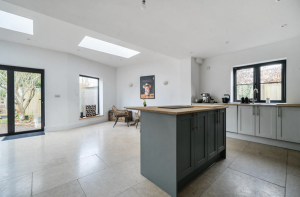
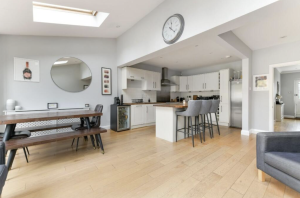
One of our Chelmsford projects shows how well this works. It is a large rear single-storey extension with a pitched roof, a roof lantern, large glazed rear doors and a kitchen island. The room is as bright as a conservatory and as practical as any other room in the house. The cost was approximately £97,000 plus VAT, including the kitchen supply and installation. That is one project, not a price list.
Big areas of glass still have to meet energy-efficiency standards, so the type of glazing matters as much as the amount. It is also worth asking your designer how the room will stay comfortable on a hot day, for example with opening rooflights or shading, because heat gain is one common concern with large glazed roofs.
This is the approach we suggest to anyone who wants lots of daylight but doesn’t want to lose the use of the room in summer or winter. Our guide to kitchen extension roof ideas goes through the roof styles in more detail.
How Kirkwood approaches kitchen extensions in Essex
We start with a free Discovery Call to understand your house, your budget and how you want to use the space. We then check whether the project can go ahead under permitted development or needs a planning permission application, and our guide to permitted development vs planning permission explains the difference. If your home is listed or in a conservation area, different rules apply, as our guide to listed building and conservation area extensions explains.
Our design team then prepares the design. Structural engineering and Building Regulations are handled in-house, and we introduce a builder we have worked with. If your budget points towards a conservatory, we will tell you honestly rather than push you towards a bigger project. For a feel for the timings, see our guide to how long a house extension takes.
Not sure which option suits your home? Book a free Discovery Call, and we will talk through it with you.
Book a Free Discovery Call
No, you don’t need a registered professional carrying that specific title for a house extension. What you do need is proper planning drawings, structural engineering, and building regulations drawings, and Kirkwood produces all three in-house for extensions across Chelmsford, Brentwood, Billericay, Wickford, Basildon, Rayleigh, Leigh-on-Sea, Southend, and the surrounding areas of Essex.
Frequently Asked Questions
Is a kitchen extension better than a conservatory?
If you want an open-plan kitchen you can use in every season, a full extension is usually the better choice. It meets building regulations, keeps its heat, lasts longer and adds more value. On a smaller budget, a conservatory can still be a sensible starting point.
Do I need planning permission for a kitchen extension in Essex?
Often you don’t, because many kitchen extensions fit within permitted development. The answer depends on the size, the height and how much of your garden is already built on. Kirkwood checks this at the start of the process, so you know the route before you spend on design.
What is the difference between an orangery and a conservatory?
A conservatory is mainly a glazed frame, whereas an orangery has solid masonry walls or piers with glazing between them. That makes an orangery better insulated and more permanent. It is also usually subject to building regulations.
Does a conservatory add value to a house in Essex?
Yes, though usually less than a kitchen extension for the same spend. As a rule of thumb, a conservatory adds about 5–7% to a property’s value, against 10–15% for a kitchen extension.
How much does a kitchen extension cost in Essex?
One of our Chelmsford projects, a large rear single-storey extension, came to approximately £97,000 plus VAT, including the kitchen supply and installation. A smaller kitchen extension can come in between £50,000 and £70,000. Professional fees for design, structural engineering and Building Regulations are additional, typically £4,000 to £8,000 depending on the size of the project.
Explore our Services

Get an instant design & build quote
Where would you like to extend?

Detached

Semi Detached

Terrace

Bungalow
Kirkwood articles
Straight-talking architecture
Areas We Cover in Essex
We’re proud to help homeowners all across Essex. Some of the areas we serve include: